United States (English)
 Russia (Pусский)
 France (Français)
 China (中文)
 Spain (Español)
 Germany (Deutsch)
 Portugal (Português)
 Slovakia (slovenský jazyk)
 Australia (English)
 New Zealand (English)
EV Charging Stations
Language


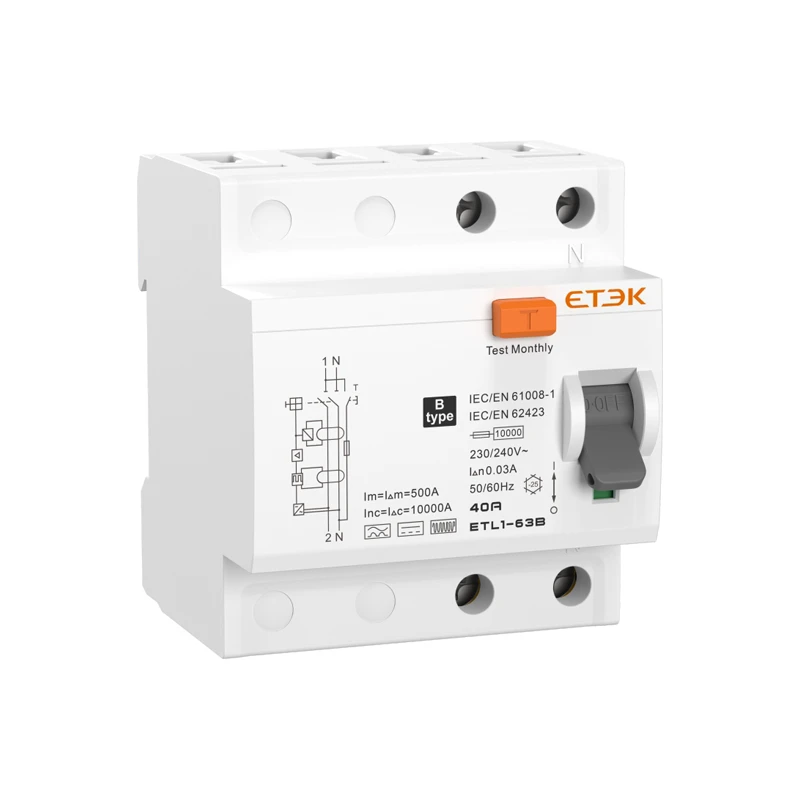

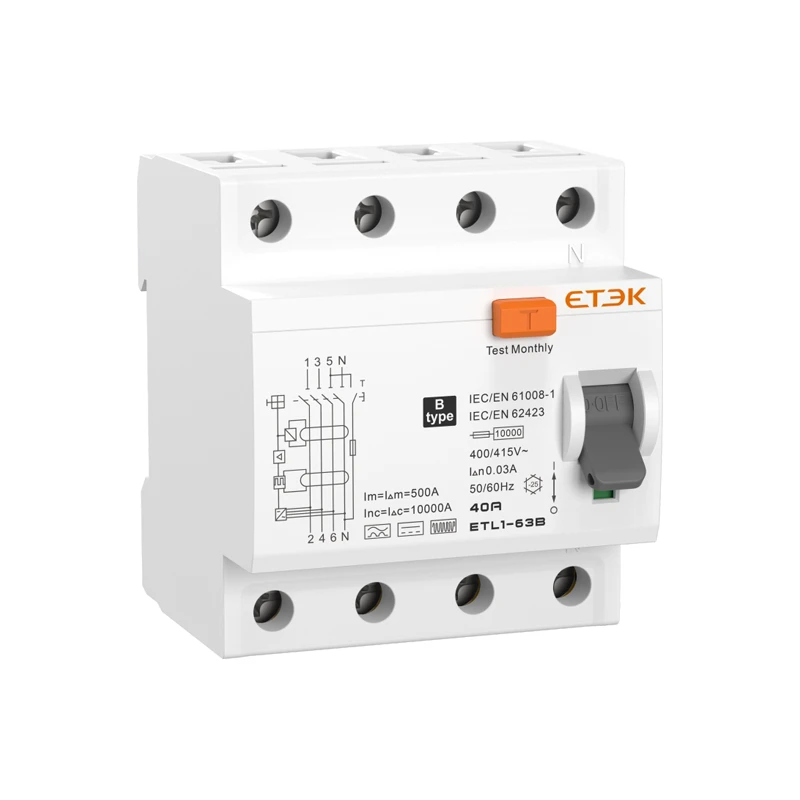
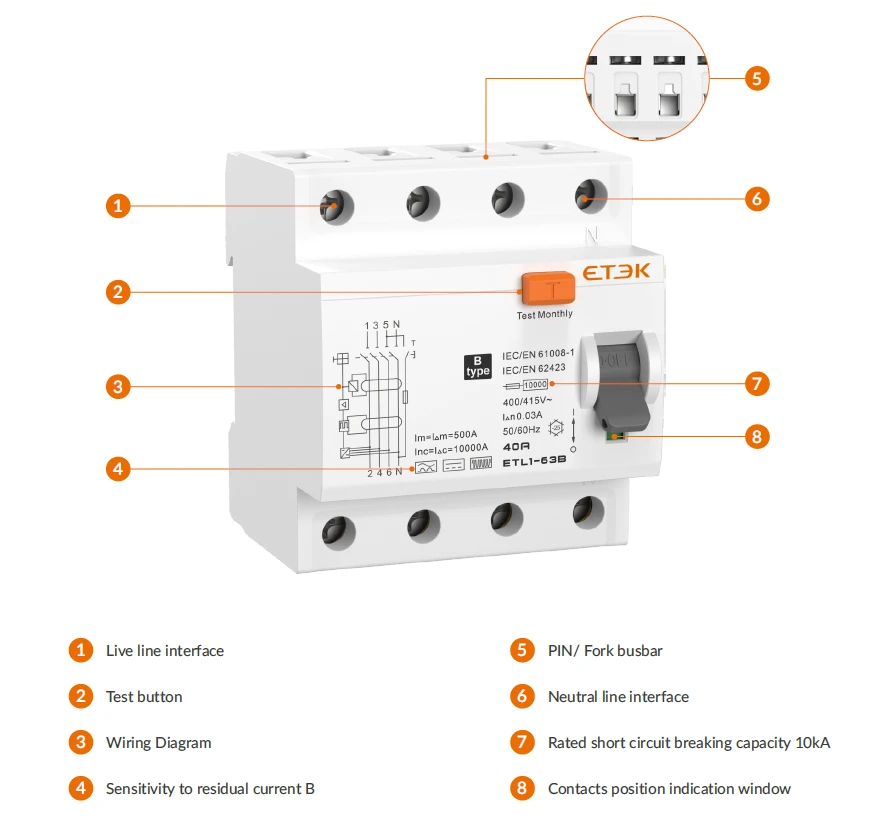
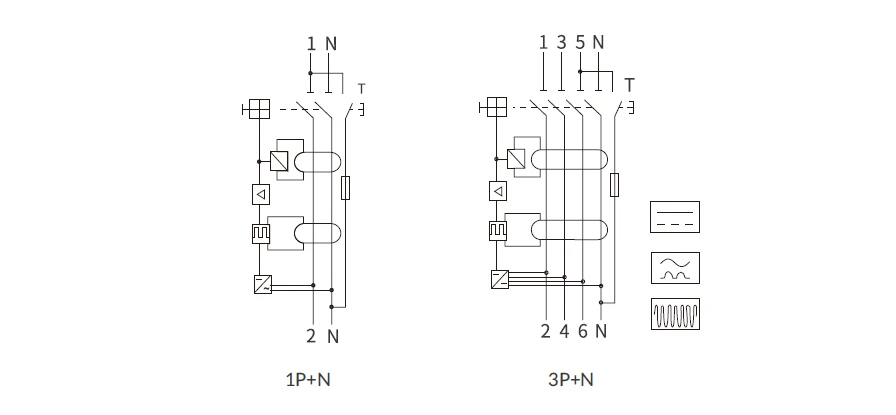
ETL1-63B Type B Residual Current Circuit Breaker (RCCB) suitable for 230/240V (1P+N) or 400/415V (3P+N) power systems, with a rated current up to 63A. Designed to detect AC leakage currents, pulsating DC leakage currents, smooth DC leakage currents, composite waveform leakage currents, and high-frequency leakage currents up to 1kHz.
When human electric shock occurs or circuit leakage current exceeds specified values, the circuit breaker instantaneously disconnects the faulty power supply to protect personnel and electrical equipment. It can also serve for infrequent circuit switching operations under normal conditions.
| Technical Data | |
| Standard | IEC/EN 61008-1,IEC/EN 62423 |
| Protection | Ground fault |
| Type of trip | Electro-magnetic type |
| Residual current type | B Type -residual AC,pulsating and smooth DC current,high frequency(≤1kHz) |
| Time characteristic | Insensitivity |
| No.of poles | 1P+N,3P+N,N Pole on the right |
| Insulation voltage (Ui) | 500V |
| Rated voltage (Ue) | 1P+N:230/240V~;3P+N:400/415V~ |
| Rated currents (In) | 16,25,32,40,63A |
| Rated sensitivity currents(I△n) | 30,100,300mA |
| Residual current off-time under(I△n) | ≤0.1s |
| Rated residual making and breaking capacity(I△m) | 500A(In≤50A) |
| 10ln(In>50A) | |
| Rated frequency | 50/60Hz |
| Rated short-circuit capacity(lcn) | 10kA |
| Rated conditional residual short-circuit current(I△c) | 10kA |
| Rated impulse withstand voltage(Uimp)(1.2/50μs) | 4kV |
| Dielectric test voltage | 2KV(50/60Hz,1 min.) |
| Fire resistance(glow-wire test) | 960±15℃(Enclosure) |
| 650±10℃(Handle) | |
| Electrical life | 2,000 Cycles |
| Mechanical life | 4,000 Cycles |
| Contact position indicator | green OFF/red ON |
| Protection degree | IP20 |
Ambient temperature |
-25℃~+40℃ |
| Storage temperature | -30℃~+70℃ |
| Terminal connection type | Cable/Pin-type/Fork-type busbar |
| Max.terminal size for cable | 16mm²flexible/25mm²rigid |
| Max.tightening torque | 2.5N.m |
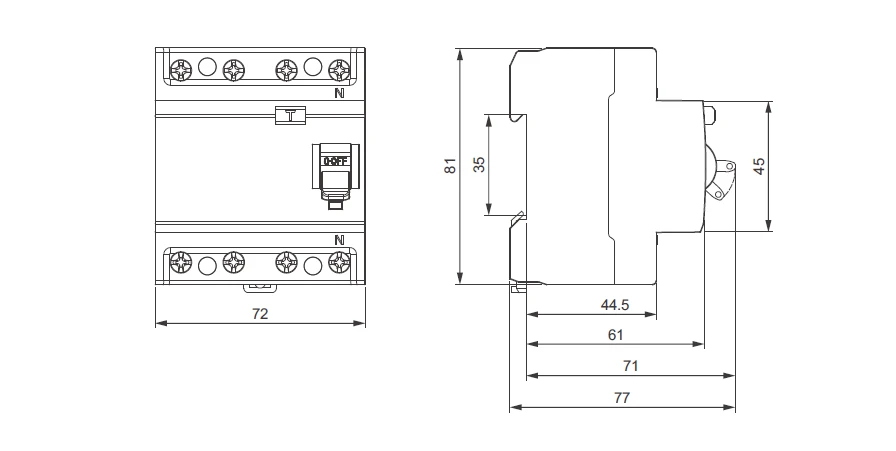
| Installation | Mounting on 35mm DIN rail |
| Incoming method | Bi-directional |