 United States (English)
 Russia (Pусский)
 France (Français)
 China (中文)
 Spain (Español)
 Germany (Deutsch)
 Portugal (Português)
 Slovakia (slovenský jazyk)
 Australia (English)
 New Zealand (English)

Why does a surge protective device need both Class I and Class II ratings?
A mile away, lightning strikes the ground. No direct hit. No visible damage. Yet inside the solar combiner box, a voltage spike races down the DC cables from the panels. The surge passes through the bus bars, toward the inverter. At the input terminals, a small device clamps the voltage. The surge current diverts to ground. The inverter continues running. The lights in the building never flicker. The equipment that was protected never knew a threat existed.
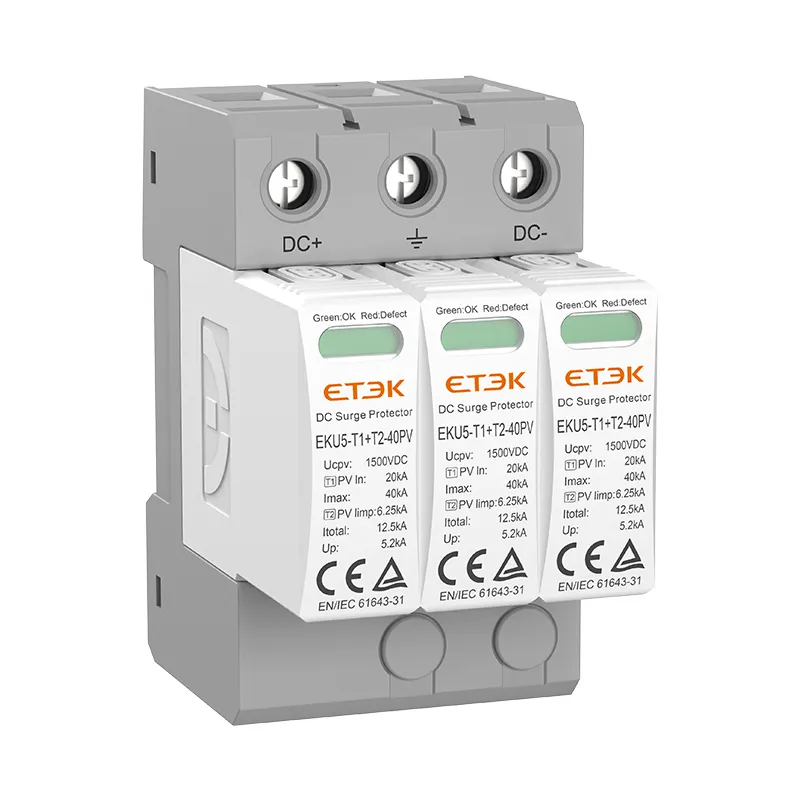
That is the function of a surge protective device A Class I+II DC surge protector is designed specifically for photovoltaic systems with string voltages up to 1500V DC. The EKU5-T1+T2-40PV series from ETEK is a Type 1+2 combined protector, rated for a maximum continuous operating voltage (Ucpv) of 500V, 1000V, or 1500V, with a maximum discharge current (Imax) of 40kA (8/20µs) and an impulse current (Iimp) of 6.25kA (10/350µs). The device is certified to IEC/EN 61643-31, the international standard for DC surge protection in photovoltaic systems. This article explains what makes a Class I+II SPD different from a standard Class II device, how the 40kA rating translates into real protection for a 1500V string, and why the pluggable design matters when a cartridge reaches end of life.
Type 1+2: why one device replaces a two-stage protection scheme
A photovoltaic system is exposed to two different kinds of surge events. A direct lightning strike or a very close strike induces a high‑energy impulse current with a 10/350µs waveform. A distant lightning strike or a switching transient from a nearby inverter produces a lower‑energy surge with an 8/20µs waveform. Traditional protection schemes use a Class I SPD at the service entrance to handle the high‑energy 10/350µs impulses, followed by a Class II SPD downstream to handle the remaining 8/20µs surges. The two devices must be separated by a decoupling distance or an inductor to ensure coordination.
A surge protective device with Type 1+2 classification combines both functions in a single housing. The internal circuit uses a spark gap or gas discharge tube for the high‑energy 10/350µs impulse and a metal oxide varistor (MOV) for the 8/20µs surge. The two stages are integrated so that no external decoupling is required. For a solar combiner box located on the roof of a building where both direct and indirect lightning strikes are possible, one Type 1+2 SPD provides complete protection without the need for cascaded devices.
The EKU5-T1+T2-40PV is rated for an impulse discharge current (Iimp) of 6.25kA per pole (10/350µs) and a total impulse current of 12.5kA across all poles, which is sufficient for most utility‑scale solar installations. The maximum discharge current (Imax) of 40kA (8/20µs) covers the switching transients generated by the inverter and by lightning strikes further away. The device is available in 3‑pole configuration, with protection modes between DC+, DC-, and PE.
| Parameter | EKU5-T1+T2-40PV Specification |
|---|---|
| Standard | IEC/EN 61643‑31 |
| Classification | Type 1+2 / Class I+II |
| Iimp (10/350µs) | 6.25kA (per pole) |
| Imax (8/20µs) | 40kA |
| Ucpv options | 500V, 1000V, 1500V DC |
| Up (voltage protection level) | ≤2.0kV at 500V, ≤4.0kV at 1000V, ≤5.2kV at 1500V |
| Response time | ≤25ns |
| Operating temperature | -40°C to +80°C |
Where the 40kA rating comes from: why you need a Class I+2 SPD
A surge protective device that is undersized will fail on the first large surge, leaving the inverter unprotected. The 40kA Imax rating means the device can safely divert up to 40,000 amperes of surge current once. For a photovoltaic system in a region with moderate lightning activity, a 20kA SPD may suffice. For a utility‑scale solar farm in Florida or the Midwest, where summer thunderstorms are frequent, a 40kA SPD provides a higher safety margin.
The device is also rated for a total discharge current (ITotal) of 40kA (8/20µs) and 12.5kA (10/350µs), meaning the combined surge current across all three poles. If a lightning strike induces 15kA on the DC+ line and 10kA on the DC- line, the SPD will divert both without exceeding its rating. The housing is made of thermoplastic rated UL94-V0, so if an internal component fails under extreme overvoltage, the housing will not sustain a flame.
The 1500V DC rating is critical for modern PV systems. Higher string voltages reduce cable losses and allow longer strings between combiner boxes. A 1500V array requires a DC SPD rated for that voltage, not a 1000V unit that would fail when string voltage exceeds its rating. The EKU5-T1+T2-40PV is available in 500V, 1000V, and 1500V configurations, with a voltage protection level (Up) of ≤2.0kV at 500V, ≤4.0kV at 1000V, and ≤5.2kV at 1500V. At 1500V DC, the clamping voltage is well below the insulation rating of a typical inverter.
Voltage protection level and IEC 61643-31: why the numbers on the label matter
The voltage protection level (Up) is the maximum voltage that will appear at the SPD terminals when it is diverting a surge. For the EKU5-T1+T2-40PV, Up is 5.2kV at 1500V DC. That is the voltage that the downstream equipment — the inverter, the cables, the combiner box bus bars — must withstand. The insulation rating of a typical 1500V DC inverter is 5‑6kV. A Up of 5.2kV is within that margin, but only just. If the Up were 6.5kV, the inverter might fail even with the SPD in place.
The IEC 61643‑31 standard is the international specification for DC surge protective devices used in photovoltaic systems. It defines the test waveforms, the classification system (Type 1, Type 2, and Type 1+2), and the performance parameters. A SPD that carries the IEC 61643‑31 mark has been tested to withstand a defined number of surge impulses at its rated current without failing. For a PV system that must pass commissioning inspection in Europe or other markets that adopt IEC standards, the certification is not optional.
The response time of the SPD is specified at ≤25ns. That is fast enough to protect modern silicon carbide (SiC) inverters, which have switching frequencies in the tens of kHz and are sensitive to voltage overshoot. A slower SPD would allow the leading edge of the surge to pass before clamping, potentially damaging the inverter's input capacitors.
Pluggable cartridges and visual indication: why maintenance is a 30‑second job
A surge protective device wears out over time. Each time it diverts a surge, the MOV degrades slightly. After hundreds of small transients or one large lightning strike, the device will eventually fail. A failed SPD must be replaced. On a hard‑wired device, this requires de‑energizing the panel, disconnecting the wires, removing the old unit, installing a new one, and re‑connecting. That is a maintenance event that takes 30‑60 minutes and requires a qualified electrician.
The EKU5‑T1+T2‑40PV uses a pluggable cartridge design. The base remains wired to the combiner box. The protection modules plug into the base and are held in place by retaining clips. When a cartridge fails — indicated by a mechanical window that changes from green to red — the technician pulls it out and pushes a new cartridge in. The panel stays live, and the replacement takes under two minutes. The pluggable design also simplifies initial installation; the base can be mounted and wired, and the cartridges inserted last, reducing the chance of damaging the electronics during panel wiring.
An optional remote signaling contact can be wired to a PLC or SCADA system. When a cartridge fails, the system generates an alarm, and maintenance is dispatched with a replacement module. For a utility‑scale solar plant with hundreds of combiner boxes, that remote alert saves days of inspection time.
Where to install the SPD in a 1500V PV system
A PV system requires protection at multiple levels. The EKU5‑T1+T2‑40PV is intended for installation at the DC input of the combiner box and at the DC input of the inverter. The manufacturer recommends installation at both ends of the DC power supply line — the solar panel side and the inverter side — especially if the line routing is external and long.
The device is mounted on a 35mm DIN rail (EN 60715). The cross‑section area of the connecting conductor should be at least 4mm² and no more than 35mm². The grounding conductor must be sized to handle the surge current; a 6mm² copper conductor is recommended for the 40kA unit. The SPD is rated IP20, suitable for installation inside a NEMA‑rated or IP65 combiner box. The operating temperature range is -40°C to +80°C, covering extreme rooftop conditions in desert climates and cold‑weather installations.
For a utility‑scale solar farm, the SPD should be installed at the output of each combiner box, before the DC cable runs to the inverter. For a commercial rooftop array, a single SPD at the inverter DC input may be sufficient, depending on the string length and the lightning risk assessment. The IEC 62305 standard provides guidance on calculating the expected lightning strike frequency for a given installation.
How the EKU5‑T1+T2‑40PV fits into a solar PV protection strategy
ETEK Solar manufactures the EKU5‑T1+T2‑40PV as part of a family of DC surge protective devices for photovoltaic systems. The product line includes Type 1+2 SPDs (40kA, 12.5kA ratings) and Type 2 SPDs for downstream protection. The EKU5‑T1+T2‑40PV is designed for the DC side of utility‑scale solar farms, commercial rooftop arrays, and industrial solar installations. It is certified to IEC/EN 61643‑31, carries a CE mark, and is available in 500V, 1000V, and 1500V configurations. The pluggable design allows for tool‑free replacement of failed modules, and the status indicators provide local visual fault detection. An optional remote signaling contact is available for integration with plant SCADA systems.
A surge protective device that combines direct lightning protection and switching transient suppression in one unit reduces installation complexity, lowers parts inventory, and ensures that both a nearby lightning strike and an inverter switching event are handled by the same device. For a solar plant operator who has replaced one too many inverter boards after a summer thunderstorm, the EKU5‑T1+T2‑40PV provides the 1500V DC rating, 40kA surge capacity, and pluggable maintenance convenience that keep the array producing power through storm season.
【Request a quote from ETEK Solar】
Contact ETEK Solar with your system voltage (500V, 1000V, or 1500V DC), the number of strings per combiner box, and your lightning risk zone to receive an SPD configuration recommendation and a sample pluggable module.