 United States (English)
 Russia (Pусский)
 France (Français)
 China (中文)
 Spain (Español)
 Germany (Deutsch)
 Portugal (Português)
 Slovakia (slovenský jazyk)
 Australia (English)
 New Zealand (English)

What Is a Miniature Circuit Breaker (MCB) – Protection Guide
In any commercial facility—whether a busy factory floor, a high-rise office building, or a commercial kitchen—unexplained tripping and sudden equipment shutdowns are more than just annoyances. They lead to costly downtime, spoiled inventory, and frustrated staff. Even worse, when breakers fail to trip appropriately, the result can be melted insulation, damaged wiring, or electrical fires.
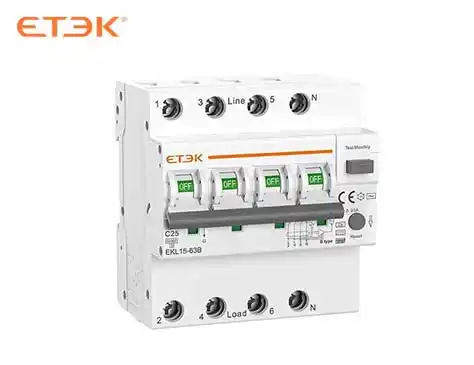
The heart of your facility’s electrical safety lies in a small but critical device: the Miniature Circuit Breaker (MCB). Understanding the miniature circuit breaker working principle is the first step toward reducing unplanned outages and protecting your assets. This guide explains how MCBs detect overloads and short circuits using a thermal magnetic trip mechanism, helping facility managers and electricians maintain safer, more reliable commercial electrical panels.
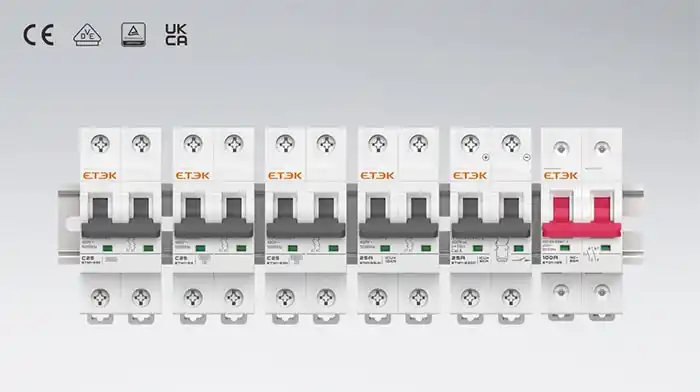
The Basic Function of an MCB in a Commercial Panel
Before diving into how an MCB works, it helps to understand its role inside your distribution board. In a typical commercial electrical panel, the MCB sits downstream of the main switch but ahead of individual branch circuits.
MCB vs. Traditional Fuse
Traditional fuses offer one-time protection: when a fault occurs, the fusible element melts and must be replaced. This creates maintenance delays and requires keeping spare fuses on hand. An MCB, by contrast, is reusable. When it trips due to a fault, you simply reset it by toggling the lever back to the “on” position—no replacement needed. This alone can save hours of downtime in a commercial setting.
Typical Ratings You’ll Encounter
Most commercial branch circuits use MCBs with these common specifications:
-
Current rating: 6A to 63A
-
Breaking capacity: 6kA or 10kA
-
Trip curves: B, C, or D
Two Types of Faults That MCB Detects – Overload and Short Circuit
An MCB is designed to respond to two distinct overcurrent conditions: overload and short circuit. Recognizing the difference helps you diagnose why a breaker tripped.
Overload occurs when the current exceeds the MCB’s rated current but remains below extreme short-circuit levels. This happens when too many devices run simultaneously on the same branch circuit—for example, plugging two portable heaters into a power strip. Overloads generate heat gradually and can persist for seconds or minutes before the breaker responds.
A short circuit is far more dangerous. It happens when the live conductor comes into direct contact with neutral or ground, creating a near-zero resistance path. The resulting current can spike to thousands of amperes in milliseconds. Without instantaneous protection, this would cause explosive arcing, melting conductors, and likely a fire.
The MCB handles both conditions using two independent internal mechanisms working together.
Inside the MCB – How Thermal and Magnetic Trips Work Together
To understand the miniature circuit breaker working principle, you must look inside the molded case. Two components perform the actual tripping: a thermal trip for overloads, and a magnetic trip for short circuits.
Thermal Trip – For Overload Protection
The bimetallic strip is made of two different metals bonded together. Each metal expands at a different rate when heated. Under a persistent overload, current flowing through the strip warms it. The unequal expansion causes the strip to bend slowly. As it bends, it releases a spring-loaded latch, allowing the breaker contacts to open.
Key characteristics of thermal tripping:
-
Time-delayed: The greater the overload, the faster it trips.
-
Heat-sensitive: Ambient temperature affects tripping speed.
-
Protects wire insulation: Prevents gradual overheating that degrades PVC or rubber insulation.
Magnetic Trip – For Short Circuit Protection
For a short circuit, speed is critical. The magnetic trip uses a solenoid coil—a few turns of heavy-gauge wire around a movable plunger. When a massive short-circuit current flows through the coil, it generates a powerful magnetic field that instantly pulls the plunger. The plunger strikes the same latch mechanism, opening the contacts in less than 10 milliseconds.
Key characteristics of magnetic tripping:
-
Instantaneous: No intentional delay.
-
Current-threshold based: Only activates above a preset multiple of rated current.
-
Arc extinguishing: High-speed contact opening, combined with an arc chute, quenches the electrical arc safely.
How they work together: In a moderate overload, the magnetic trip does nothing—current is too low. The bimetallic strip takes over, tripping after several seconds. In a dead short, the magnetic trip reacts immediately, overriding the thermal element entirely. This dual-response design is what makes the MCB so effective.
Real-World Example of MCB Protection in a Commercial Kitchen
Let’s walk through a typical scenario in a commercial kitchen to see both protection modes in action.
Setup: A single 20A type C MCB protects a branch circuit powering:
-
One reach-in refrigerator
-
One convection oven
-
One undercounter dishwasher
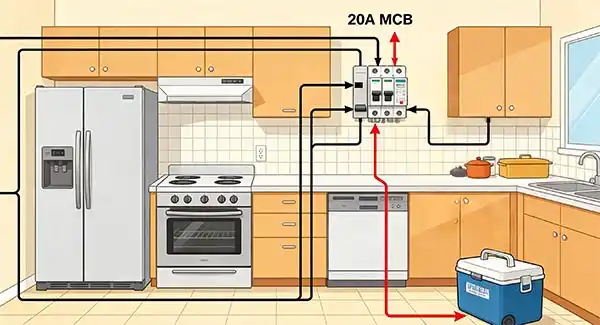
Overload scenario: During the lunch rush, staff start the oven, dishwasher, and refrigerator simultaneously while also using a portable holding cabinet plugged into the same circuit. Total current reaches 26A—above the 20A rating but far below a short circuit. The bimetallic strip heats up. After about 30 seconds, it bends enough to trip the MCB. The kitchen loses power to that circuit, but the breaker has prevented the building’s 14-gauge wiring from reaching dangerous temperatures that could melt insulation and start a fire behind the walls.
Short circuit scenario: A maintenance worker accidentally drives a screw through the dishwasher’s power cord, connecting live and neutral wires. Instantaneous current soars to 800A. The magnetic trip reacts in less than 0.01 seconds. The contacts open, extinguishing the arc before any flame develops. The refrigerator and oven shut off, but the facility avoids a potentially catastrophic fire.
Why this matters for your facility: That same protection applies to lighting circuits, data center power strips, and manufacturing equipment. Every time an MCB trips without visible smoke or heat damage, it has likely just saved your facility from a much larger problem.
Frequently Asked Questions About MCB Operation
Q1: Can an MCB trip without any visible overload?
Yes. Common causes include:
-
Motor starting inrush: Large motors draw 6–10× their running current for a few cycles. If multiple motors start simultaneously, the cumulative inrush can mimic a short circuit and trip the magnetic element.
-
Loose connections: A loose terminal screw inside the panel creates heat that migrates into the MCB, causing thermal tripping even at normal currents.
-
Aging breaker: After many years and multiple trips, the bimetallic strip can weaken, causing nuisance tripping at lower currents.
Q2: What happens if I install an MCB with a higher amp rating than the wire?
This is a serious fire hazard. For example, installing a 32A MCB on a 2.5mm² wire means the wire will overheat and potentially melt its insulation long before the breaker’s thermal trip activates. The MCB will not protect the circuit—the wire becomes the weak link. Always match the MCB rating to the smallest wire gauge in the circuit.
Q3: How often should MCBs be tested in a commercial building?
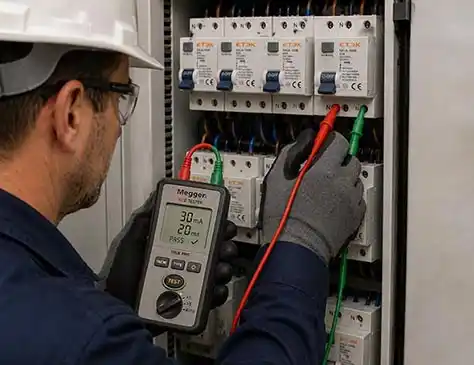
Conducting routine functional testing on installed equipment is often difficult to implement. Instead, the following measures are recommended:
- Annual Inspection: Engage a professional electrician to perform a thermal imaging inspection of the distribution board. If "hot spots" are detected at the incoming or outgoing terminals of an MCB, this indicates loose wiring or abnormal internal resistance.
- Following a Fault Trip: If an MCB trips due to a short-circuit fault, it is recommended that the unit be replaced. High-magnitude fault currents can cause internal contact damage within the circuit breaker, even if the device subsequently appears to reset and function normally.
Summary and Next Steps for Facility Managers
Understanding the miniature circuit breaker working principle transforms how you respond to electrical issues. Instead of simply resetting a tripped breaker and hoping for the best, you can now diagnose whether the cause was a gradual overload or a dangerous short circuit.
Three immediate actions for your facility:
-
Log every trip event. Record the date, circuit location, and what equipment was running. If you see repeated overload trips on the same circuit, the solution is to redistribute loads or add a new branch circuit—not to install a larger MCB.
-
Never force a reset. If an MCB trips immediately after you reset it, do not hold the lever in the “on” position. This indicates a persistent short circuit or a dead ground fault. Call a qualified electrician.
-
Verify ratings during maintenance. When replacing an MCB, match exactly: same current rating, same trip curve, and at least the same breaking capacity. Substituting a higher-rated or lower-breaking-capacity unit compromises safety.
For assistance selecting the correct MCB for commercial lighting, HVAC, or kitchen circuits—or to request thermal imaging of your panel—contact our technical team. A well-protected facility is one where breakers trip on purpose, not by accident.