 United States (English)
 Russia (Pусский)
 France (Français)
 China (中文)
 Spain (Español)
 Germany (Deutsch)
 Portugal (Português)
 Slovakia (slovenský jazyk)
 Australia (English)
 New Zealand (English)

How to Select the Right RCBO for Commercial Distribution Boards
Choosing the right protective device for a commercial distribution board can be a headache. Pick the wrong one, and you'll face nuisance tripping, insufficient fault protection, poor reliability, and costly downtime. I've seen it happen plenty of times – a circuit that looks fine on paper starts tripping as soon as a small motor starts up, and you spend hours tracing it back to a mismatched tripping curve.
An RCBO provides both overcurrent and earth leakage protection in a single module. To choose the right device for your commercial application, you need to evaluate these five key technical parameters.
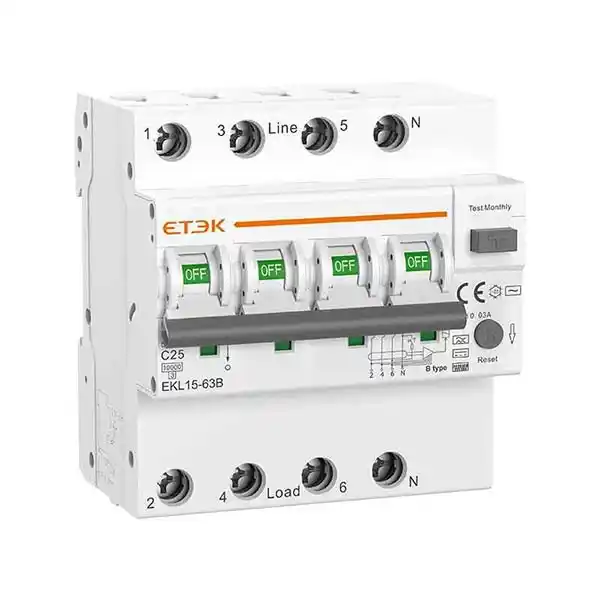
Rated current and tripping curve
The rated current must match the expected load and the conductor size. Common ratings: 6A, 10A, 16A, 20A, 25A, 32A, 40A.
One thing people often miss: bigger isn't better. Some engineers go one size up "to be safe", but then the conductor overheats before the device trips. Always match the rating to the actual cable cross-section and installation conditions.
The tripping curve determines how the RCBO responds to inrush currents.
-
B curve (trips at 3–5× rated current): For resistive loads – heaters, incandescent lighting, general residential loads. These have very little inrush current, so a B curve trips fast without nuisance trips. Not common in commercial work, but fine for pure lighting circuits.
-
C curve (5–10×): Small motors, transformers, fluorescent lighting, LED drivers, office equipment. This is the go-to for most commercial distribution boards. Most office equipment has some inrush, and C curve strikes a good balance between protection and stability.
-
D curve (10–20×): Welders, X-ray machines, large motors, equipment with very high inrush. But be careful – a D curve responds slower to short circuits. Don't use it on ordinary circuits unless you've confirmed the startup current really needs it.
Practical tip: When in doubt, check the inrush current of the load. For small motors, C curve is usually enough unless they start/stop very frequently.
Earth leakage sensitivity and trip time
Pick the wrong sensitivity – you either compromise safety or get nuisance trips every day. Leakage protection works differently from overcurrent protection; it relies on a zero-sequence current transformer, so wiring is critical.
-
30mA : Primarily for personal shock protection. Codes typically require 30mA for socket outlets, temporary supplies, and public areas. This value is based on the maximum current the human body can tolerate, and the trip time is usually <0.1s.
-
100mA / 300mA : These are for fire protection, not direct personnel protection. Suitable for main incomers, distribution feeders, long cable runs, equipment rooms. Why? Because normal leakage from many devices – computers, power supplies – can add up to more than 30mA. If you put a 30mA device on a main switch, it will trip constantly. A 100mA or 300mA device ignores that normal leakage but still trips when insulation degrades enough to cause a fire.
-
Time-delayed (S-type) : These intentionally delay tripping. The benefit is selectivity – a downstream 30mA RCBO trips first. If it fails, the upstream time-delayed device trips a short while later. That way a single faulty socket doesn't kill power to an entire floor. Selectivity is critical in commercial buildings where uptime matters.
One rule of thumb from the field: For lighting circuits with LED drivers, start at 100mA. For socket outlets, always 30mA. For the main incoming supply, 300mA time-delayed – that's a solid, conservative setup.
Pole configuration
The number of poles must match the system earthing arrangement. This trips up a lot of people.
-
1P+N : Common for single-phase circuits. Switches the phase and also switches the neutral. Compact and lower cost. Good for lighting and small power circuits. Note: With 1P+N, if the upstream neutral breaks, the device can't isolate the neutral – so be careful during maintenance.
-
2P : Switches both phase and neutral, with overcurrent and leakage protection on both poles. Safer for maintenance. Suitable for TT earthing systems (neutral directly earthed, separate earth for exposed conductive parts). In a TT system, if you only switch the phase, the neutral may still be at a hazardous potential.
-
3P : Three-phase without neutral. For pumps, motors, industrial machinery. All three poles are protected.
-
4P : Three-phase with neutral. For HVAC units, elevators, large air conditioners, distribution feeders.
Before choosing poles, check the earthing system. In a TN-C system you can't just switch the PEN conductor, so 4P is rarely used. TN-S and TT systems can use 2P or 4P. Look at the single-line diagram and earthing notes before ordering.
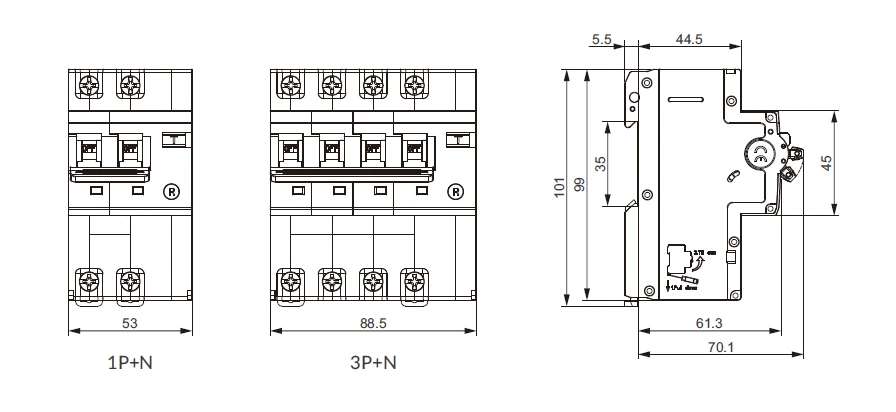
Physical width and busbar compatibility
Distribution board space is often tight, especially in retrofits. Open an old panel and it's packed like sardines – try to stuff a 2-module wide RCBO in there and you might not even close the door.
Standard module width: 1 module = 18mm. Older RCBOs may take 2 modules or more. Modern single-module RCBOs (18mm) save up to 50% of space. That means a smaller enclosure and easier future expansion.
But – and this is a big but – always verify busbar compatibility before buying. Different manufacturers use different busbar tooth spacing, terminal shapes, and connection methods. I've seen cases where the electrical ratings were perfect, but the device simply wouldn't clip onto the busbar, or the terminal height was off. Wasted money is one thing; delayed project is worse.
So: get the dimensional drawing from the manufacturer and compare it with your panel's busbar layout. For retrofit projects, check with the original panel builder if possible.
Breaking capacity
Breaking capacity is the maximum fault current the RCBO can safely interrupt. If the actual fault current exceeds this rating, the device can literally explode – I'm not exaggerating.
-
6kA : Adequate for most commercial buildings – offices, retail stores, schools. These usually have relatively small transformers, so the prospective short-circuit current rarely exceeds 6kA.
-
10kA or higher : Needed near large transformers, industrial facilities, large commercial complexes. Low impedance means fault currents can easily exceed 6kA.
Common mistake : Assuming the MCB and RCBO versions in the same family have the same short-circuit rating. In many product families, the MCB might be 10kA while the RCBO is only 6kA. Why? Because the RCBO has additional leakage detection components that affect its interrupting performance. Always check the datasheet – don't guess.
Another tip: Higher breaking capacity isn't always better. Specify what you actually need. Overspecifying costs more, but underspecifying is dangerous. A quick way: find the upstream transformer rating and impedance, estimate the short-circuit current, then add a small margin.
Installation tips to avoid nuisance tripping
Even a perfect RCBO will perform badly if installed wrong. Here are the most common field mistakes.
Keep neutral conductors separate : The load-side neutral must go back to its own terminal on the RCBO. Never share neutrals between different RCBOs. Some electricians use a neutral busbar and tie all neutrals together – that will cause immediate tripping because the RCBO sees an imbalance between phase and neutral. Also, never connect neutral to earth downstream of an RCBO; that also creates a false residual current.
Verify three-phase wiring : For 3P or 4P RCBOs, check the phase sequence and the orientation of the current transformers. Follow the manufacturer's wiring diagram. A wrong connection can cause false leakage detection even when there's no actual fault.
Test after installation : Press the test button on every RCBO after commissioning. Verify it trips, then reset it. Record the results. This isn't just paperwork – I've seen brand new RCBOs that didn't respond to the test button, meaning a factory defect. Also schedule periodic testing to make sure the mechanism hasn't seized up.
Two common questions
Can I use a 30mA RCBO on a factory main incomer?
No. A 30mA device is for personal protection – it's very sensitive. In a factory, normal cumulative leakage from many machines will easily exceed 30mA, and the main switch will trip constantly, stopping production. For main incomers or large distribution circuits, a 300mA time-delayed device is the right choice.
What does Type A vs Type AC mean on an RCBO?
Type AC responds only to sinusoidal AC residual currents. Type A responds to both sinusoidal AC and pulsating DC residual currents. Modern commercial buildings have VFDs, LED power supplies, washing machines, elevators – all of which can produce non-sinusoidal leakage currents that Type AC may not detect. Codes are moving toward Type A. If you're unsure, just pick Type A – it's safer.
Quick checklist before you order
Before finalising your RCBO specification, run through this:
-
Draw a single-line diagram with all loads.
-
Estimate normal leakage current for each circuit.
-
Decide if you need selectivity between upstream and downstream devices – if yes, use time-delayed types.
-
Calculate or estimate the prospective short-circuit current at each point.
-
Check busbar compatibility – get dimensional drawings.
-
Ask the supplier for the latest datasheet – verify breaking capacity, curves, terminal sizes.
-
Confirm compliance with IEC, UL, or local standards.
Selecting an RCBO seems like a lot of small details, but it's really just going through these parameters one by one. Do that, install it carefully, test it, and you'll have years of trouble-free operation. Hope this saves you some headaches in the field.