 United States (English)
 Russia (Pусский)
 France (Français)
 China (中文)
 Spain (Español)
 Germany (Deutsch)
 Portugal (Português)
 Slovakia (slovenský jazyk)
 Australia (English)
 New Zealand (English)

Type B RCCB for EV Charging Stations – Complete Installation Guide
Electric vehicles are no longer a niche market—they are rapidly becoming the mainstream choice for personal and commercial transport. As a result, commercial car parks, office buildings, apartment complexes, and retail centres are installing EV charging stations at an unprecedented rate. For electrical contractors, this presents a growing business opportunity, but also a new set of technical challenges.
One of the most common issues reported by electricians is the unreliable behaviour of standard residual current devices (RCCBs) when used with EV chargers. Type AC and even Type A RCCBs often trip nuisance‑free or, worse, fail to trip when a real fault occurs. The culprit is a phenomenon unique to modern EV chargers: smooth DC residual current.
This article explains why Type B RCCBs are not just recommended but often mandatory for EV charging installations. You will learn about the physics behind DC leakage, the relevant standards, practical wiring tips, and common mistakes to avoid. By the end, you will be fully equipped to specify and install the correct protection for any EV charging project.
Why Electric Vehicle Chargers Are Different from Ordinary Loads
To understand why EV chargers pose a unique challenge, we must look inside the charger itself. A typical AC‑fed EV charger contains an AC‑DC rectifier that converts the mains alternating current into direct current to charge the vehicle’s high‑voltage battery. This conversion is performed by power electronic circuits—rectifier bridges, power factor correction (PFC) stages, and DC‑DC converters—all of which switch at high frequencies.
In normal operation, these circuits generate a small amount of leakage current due to the capacitive coupling between the live parts and the protective earth. However, under fault conditions—such as insulation breakdown inside the rectifier or damage to the DC bus—a smooth direct current can flow from the DC side directly to earth.
Smooth DC residual current is defined as a continuous, non‑pulsating direct current with a ripple content of less than 10 %. Unlike pulsating DC, smooth DC maintains a constant polarity and amplitude. This type of current is completely invisible to conventional RCCBs because their magnetic core relies on the alternating flux generated by AC or pulsating DC to trip the mechanism.
When a smooth DC current passes through the zero‑sequence transformer of a standard RCCB, it saturates the iron core. Once saturated, the core can no longer respond to superimposed AC leakage currents, rendering the device ineffective. The result: the RCCB may not trip even when a dangerous leakage current exceeds its rated sensitivity. This is why EV chargers demand a fundamentally different approach to residual current protection.
Understanding RCCB Types – Type AC, Type A, and Type B
RCCBs are classified according to the types of residual current they can detect. The table below summarises the key differences:
| RCCB Type | Detects | Typical Applications |
|---|---|---|
| Type AC | Sinusoidal alternating residual current | Resistive loads |
| Type A | Sinusoidal AC and pulsating DC | Single‑phase variable speed drives, computers, washing machines |
| Type B | Sinusoidal AC, pulsating DC, and smooth DC | EV chargers, PV inverters, frequency converters, UPS systems |
-
Type AC is the most basic and is only suitable for loads that produce purely sinusoidal leakage currents. It is inadequate for any electronic load.
-
Type A adds the ability to detect pulsating DC—currents that come from diode rectifiers and thyristor circuits. This covers many household appliances, but it still cannot detect smooth DC.
-
Type B is the only type that can detect all forms of residual current, including smooth DC up to its rated value. It employs advanced sensing technology (often a combination of a fluxgate sensor and a conventional transformer) to avoid core saturation and reliably trip on DC faults.
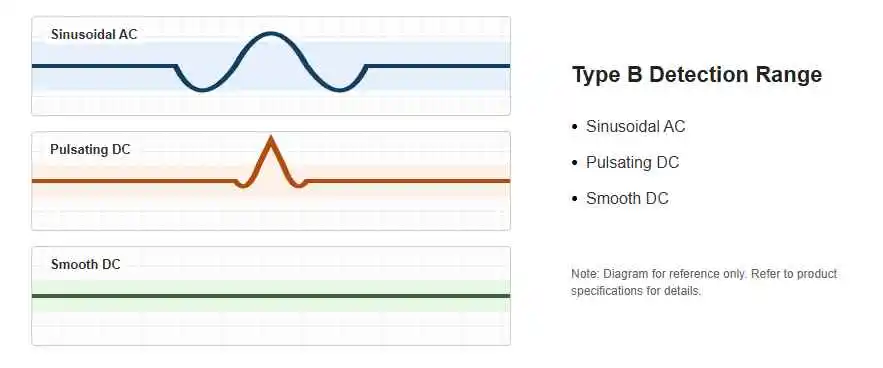
For EV charging, Type B is the only technically correct choice because the charger’s internal rectifier can produce smooth DC leakage in the event of a fault.
Smooth DC Leakage Current – The Hidden Danger
Smooth DC leakage is not just a technical curiosity—it is a serious safety hazard. Consider a typical 400 V DC bus inside an EV charger. If the insulation between the DC bus and the protective earth fails, a direct current can flow to ground. This current may be as high as several amperes, but it never crosses zero.
Why is this dangerous?
-
Undetected by Type A/AC – Because the current is constant, the magnetic sensor in a Type A RCCB does not see a changing flux; it sees a steady magnetising force that saturates the core. The device becomes blind to both DC and any AC leakage that might also be present.
-
Ventricular fibrillation risk – Research has shown that DC currents are more likely to cause ventricular fibrillation than AC currents of the same magnitude, because they interfere with the heart’s natural electrical rhythm. A smooth DC leakage of only a few tens of milliamperes can be lethal if it passes through the human body.
-
Fire hazard – Unprotected DC leakage can heat up components or create arcs that ignite surrounding materials.
The installation of a Type B RCCB is the only reliable way to detect and interrupt such faults, providing both personnel protection and fire prevention.
Relevant Standards – IEC 61851‑1 and IEC 62955
International standards have evolved to address the unique risks of EV charging. Two key documents are directly relevant to the selection of residual current protection:
IEC 61851‑1: Electric vehicle conductive charging system – Part 1: General requirements
This standard specifies that every EV charging point must provide at least one means of detecting smooth DC residual current of 6 mA or above. It offers two alternative methods:
-
Method A – The charger is equipped with an internal DC 6 mA detection device (often called a “DC‑sensitive residual current monitoring” function). In this case, a standard (Type A) RCCB may be used upstream, because the internal detector trips the charger itself when DC leakage occurs.
-
Method B – The charger does not have an internal DC detector. Instead, a Type B RCCB is installed upstream. This single device fulfils the requirement for both AC and DC protection.
Many manufacturers prefer Method A because it reduces cost, but this places the responsibility on the installer to verify that the charger is indeed equipped with a compliant internal detector. In practice, many contractors find it simpler and safer to adopt Method B by installing a Type B RCCB, eliminating any doubt about compliance.
IEC 62955: Residual direct current detecting device for EV charging
This standard specifically covers the 6 mA smooth DC detection requirement. It defines the test procedures and performance criteria for devices that detect smooth DC. While IEC 62955 focuses on internal RDC‑DD units, it also confirms that Type B RCCBs are fully compliant.
When specifying equipment, always check that the Type B RCCB is certified to IEC 62423 and, if applicable, to IEC 62955 for EV‑specific use.
Installation Tips for Type B RCCB in EV Charging Stations
Once you have decided to use Type B RCCBs, follow these practical guidelines to ensure a reliable and code‑compliant installation:
1. Proper rating selection
-
The rated current of the RCCB must be greater than or equal to the maximum continuous input current of the EV charger. For most wall‑mounted AC chargers, this is typically 32 A or 40 A. For fast chargers, you may need 63 A or higher. Always consult the charger’s nameplate.
-
The rated residual operating current is usually 30 mA for personnel protection. Type B RCCBs with 30 mA sensitivity are available and are recommended for all socket‑outlet or directly connected chargers.
2. Space planning
-
Type B RCCBs are physically larger than Type A or AC devices. They may occupy 2 or 4 modular widths depending on the manufacturer and the number of poles. Always check the datasheet and allow sufficient space in the distribution board.
3. Dedicated circuits
-
Do not share one Type B RCCB for multiple chargers unless it is used as a main incoming switch with downstream individual protection. Sharing reduces selectivity: a fault on one charger could trip the entire group, causing unnecessary downtime. For commercial installations with multiple charging points, it is best to dedicate one Type B RCCB per charger.
4. Wiring polarity
-
Type B RCCBs are often polarised; ensure that the line and neutral are connected to the correct terminals as marked. Reversing polarity can impair the internal sensing circuit.
5. Coordination with upstream devices
-
If the Type B RCCB is installed downstream of a variable frequency drive (VFD) or a large UPS, high‑frequency leakage currents from those devices may cause nuisance tripping. In such cases, consider installing an EMI filter or separating the circuits.
Common Mistakes to Avoid
Even experienced electricians can make errors when dealing with Type B RCCBs. Here are the most frequent pitfalls and how to avoid them:
Using Type AC or Type A RCCB “because it worked before”
-
This is the number one mistake. As explained earlier, these devices cannot detect smooth DC and will saturate. Many contractors have faced failed inspections and costly rework. Always check the charger’s documentation—if it does not explicitly state that it has an internal DC detector (per IEC 62955), you must install a Type B RCCB.
Installing a Type B RCCB in a circuit with downstream VFDs without filtering
-
Variable frequency drives generate high‑frequency common‑mode currents that can mimic residual current and cause nuisance tripping. If you have both EV chargers and VFDs on the same sub‑distribution board, use separate Type B RCCBs for the chargers and consider using Type B+ or selectively coordinated devices if required.
Ignoring inrush current
-
Many EV chargers have large input capacitors that draw a significant inrush current when energised. This can cause a standard instantaneous RCCB to trip on the first power‑up. To avoid this, select a Type B RCCB with a short‑time delay (often denoted as “S” or “selective”). These devices tolerate momentary surges without tripping, ensuring stable operation.
Forgetting to test with the correct equipment
-
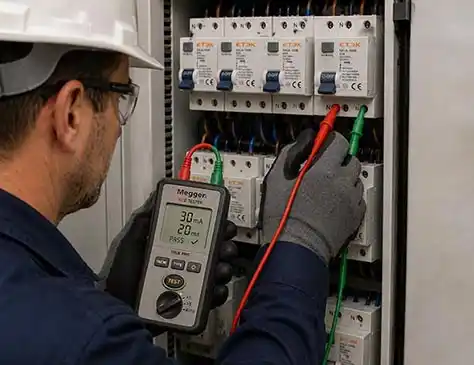
The test button on a Type B RCCB typically generates a simulated AC residual current—it does not test the smooth DC detection capability. To verify the DC function, you need a specialised tester that can inject a calibrated smooth DC current. Many manufacturers offer portable testers; include this in your commissioning checklist.
Frequently Asked Questions
Q: Can I use a Type B RCBO instead of a separate MCB + Type B RCCB?
A: Yes. A Type B RCBO combines overcurrent protection and residual current detection in a single modular device. It saves space and simplifies wiring. Ensure that the rated current and breaking capacity are suitable for your charger.
Q: Is Type B RCCB required by the NEC in the United States?
A: The US National Electrical Code (NEC) Article 625 requires GFCI protection for EV charging equipment, typically Class A (5 mA) for personnel protection. However, the NEC does not explicitly mandate Type B devices for smooth DC. Local Authorities Having Jurisdiction (AHJs) may interpret the code differently; many now require DC‑sensitive protection. Always check with the local inspector and the charger manufacturer’s instructions.
Q: How do I test a Type B RCCB for DC response?
A: You need a dedicated RCCB tester that can generate a smooth DC residual current, usually adjustable from 0 to 100 mA. Connect the tester between the load side phase/neutral and earth, and ramp up the DC current to verify tripping at or below the rated IΔn. The test button only tests the AC path and is not sufficient.
Q: Can I put multiple EV chargers behind one Type B RCCB if each charger has its own internal DC detector?
A: Technically yes, because the internal detectors provide individual protection. However, a single upstream RCCB does not offer selectivity—a fault in one charger will disconnect all. For critical installations, separate RCCBs per charger are strongly recommended.
Q: What about three‑phase EV chargers?
A: Three‑phase chargers also require Type B protection because they contain rectifiers that can produce smooth DC. Select a 4‑pole Type B RCCB (3 phases + neutral) with the appropriate rated current. Ensure the neutral is connected if the charger uses a single‑phase auxiliary supply.
Next Steps for Your EV Charging Project
Now that you understand the critical importance of Type B RCCBs for EV charging, here is a practical action plan for your next project:
-
Review the charger datasheet – Look for the “residual current protection” section. Confirm whether it includes an internal 6 mA DC detector (IEC 62955 compliant). If not, you must supply a Type B RCCB.
-
Select a certified Type B RCCB – Choose a device bearing recognised marks such as TUV, VDE, or UL. Ensure it meets IEC 62423 and, preferably, IEC 62955.
-
Design for selectivity – Plan a distribution architecture where each charging outlet has its own dedicated Type B RCCB (or RCBO). This minimises downtime and simplifies troubleshooting.
-
Prepare the distribution board – Allocate sufficient space for the wider modules. Consider future expansion—additional chargers may be added later.
-
Install and test – Follow the manufacturer’s wiring instructions carefully. After installation, perform a complete test using a smooth‑DC‑capable tester and document the results.
-
Educate the end user – Explain why a Type B RCCB is installed and advise them not to replace it with a different type.
By following these steps, you will deliver a safe, standards‑compliant, and reliable EV charging installation that stands the test of time. The move to electric mobility is irreversible—equip yourself with the right knowledge and components, and you will be at the forefront of this growing market.
This guide is for informational purposes only. Always consult local electrical codes and the specific manufacturer’s instructions for your equipment.