 United States (English)
 Russia (Pусский)
 France (Français)
 China (中文)
 Spain (Español)
 Germany (Deutsch)
 Portugal (Português)
 Slovakia (slovenský jazyk)
 Australia (English)
 New Zealand (English)

AFDD vs RCBO – Do You Need Both for Fire Protection?
When it comes to electrical fire prevention, many professionals first think of the RCBO – a device that combines overcurrent, short‑circuit, and earth leakage protection into one module. It often seems like a “one‑size‑fits‑all” solution. But have you considered that even with a panel full of RCBOs, a latent fire risk may still exist?
This article compares AFDD (Arc Fault Detection Device) and RCBO from the perspectives of technical principles, fire mechanisms, and real‑world applications. It will help you make informed decisions for critical electrical installations.
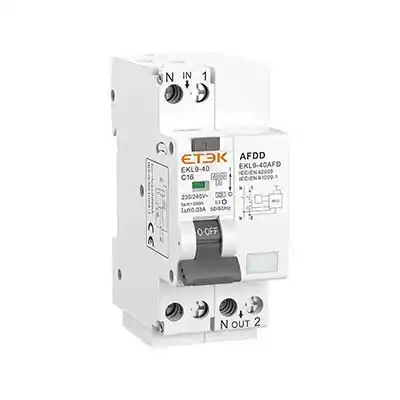
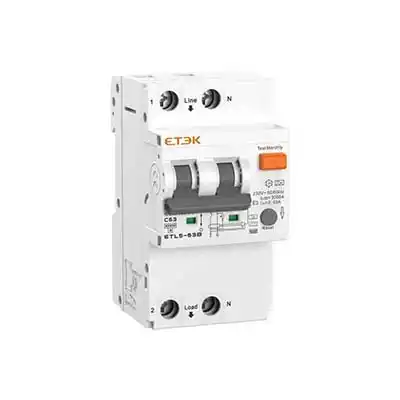
What Kind of Electrical Fires Can an RCBO Prevent?
The core functions of an RCBO can be summarised in three areas: RCD + MCB. Specifically, an RCBO can prevent:
-
Overload leading to insulation ageing and fire – When the actual current exceeds the cable’s rated capacity, the thermal trip mechanism of the RCBO operates with a time delay, cutting off the circuit before the cable overheats and ignites its insulation.
-
Short‑circuit producing a high‑temperature arc – In the event of a metallic short‑circuit, the large fault current instantly triggers the electromagnetic trip mechanism. The RCBO disconnects the circuit within milliseconds.
-
Earth leakage generating sparks – When damaged insulation allows current to flow to earth, the residual current detection module in the RCBO can sense leakage currents and quickly interrupt the circuit, preventing sparks along the earth path.
Limitation: RCBOs are not designed to detect dangerous arc faults. AFDDs use microprocessor‑based waveform analysis to detect hazardous arc faults, whereas traditional protection devices like RCBOs and MCBs have relatively low sensitivity to these arcs.
In short: an RCBO protects people and circuits against leakage, overload and short‑circuits. An AFDD protects buildings against electrical fires caused by arc faults. These devices address different risks – which is why many electrical installations use both types of protection together.
What Is a Series Arc and Why Is It Dangerous?
To understand why AFDDs are indispensable, you first need to grasp the concept of a series arc.
Arc faults are divided into two main types: series arcs and parallel arcs.
A series arc occurs at a break point within the same conductor – for example, a loose connection inside a socket, a cracked copper strand inside a plug, burnt switch contacts, or tiny cracks inside a cable.
The danger of this fault lies in the fact that the current in a series arc is limited by the load. Consider a 60 W lamp drawing only 0.25 A under normal conditions. Even if a series arc occurs, the fault current is still limited by the lamp’s impedance to a few milliamps – typically 2 A to 10 A, far below the operating threshold of a standard RCBO or MCB.
In other words, a socket circuit with a serious loose connection looks perfectly “healthy” to an RCBO. Yet the temperature of a series arc can exceed 2000 °C, enough to instantly ignite nearby combustibles. According to fire statistics in the UK, faults of this type – involving appliances and leads – account for as many as 23% of electrical fires.
A series arc remains “invisible” because its current waveform is similar to that of a normal load. However, its high‑frequency noise and the “flat shoulder” shape at current zero‑crossing become the key features that an AFDD uses for identification. By continuously monitoring the high‑frequency components of the current waveform, the AFDD can detect a dangerous arc and disconnect the faulty circuit within milliseconds – orders of magnitude faster than the thermal trip of an RCBO.
How an AFDD Detects Both Series and Parallel Arcs
An AFDD is an electronic device specifically designed to detect hazardous arc faults. Its core technology is a microprocessor that continuously analyses the electrical waveform, distinguishing normal switching events from real dangerous arcs.
Detecting Series Arcs
The AFDD constantly monitors high‑frequency noise and the waveform distortion at current zero‑crossing. When it detects a pattern that matches a dangerous series arc, it issues a trip command. According to IEC 62606, an AFDD must reliably detect series arcs and automatically disconnect the faulty circuit. Products from brands such as ABB can protect against series arcs, parallel arcs, earth arc faults, overload and overvoltage, achieving a far higher monitoring precision than traditional devices.
Detecting Parallel Arcs
A parallel arc occurs between line and neutral or between line and protective earth. RCBOs are more likely to detect high‑energy parallel arcs because the short‑circuit current is large and can activate the electromagnetic trip instantaneously. However, in the early stages a parallel arc may behave like a “leakage” with relatively high impedance – a condition an RCBO often fails to recognise. An AFDD acts as a back‑up protection, clearing the fault even before the RCBO would operate.
Note on nuisance tripping: Some equipment draws an inrush current that can be several tens of amperes. Its waveform may resemble a parallel arc and could cause unwanted tripping of an AFDD. In laboratory environments, AFDDs on circuits with heavily filtered loads may sometimes fail to detect series arcs reliably. Therefore, it is essential to choose established brands that have passed rigorous anti‑interference tests. Eaton, for instance, has introduced “AFDD+” products that specifically suppress common interference sources such as carbon‑brush sparks from vacuum cleaners and power tools, significantly reducing the nuisance trip rate.
Scenarios Where an AFDD Is Strongly Recommended
According to IEC, the following types of final circuits shall be protected against the risk of fire due to arc faults in the final circuit by an Arc Fault Detection Device:
-
Socket‑outlet circuits in locations where people sleep – e.g. nursing homes, residential care facilities for persons with disabilities, hotels, primary schools, kindergartens, dwellings.
-
Locations classified as BE2 due to a higher risk of fire due to the nature of processed or stored materials – e.g. barns, woodworking shops, paper mills.
-
Locations storing irreplaceable items – museums, historic buildings, archives.
-
Workplaces in high‑rise buildings.
-
Agricultural premises housing livestock.
Furthermore, the same standard recommends that other final circuits be protected by an AFDD.
Guidance from manufacturers such as Eaton adds that AFDDs are particularly recommended for hotel rooms, sleeping areas in kindergartens or care homes, barns and woodworking workshops, warehouses storing combustible materials, wooden buildings, national monuments, museums, and public premises such as airports and railway stations.
AFDD Application Recommendations by Building Type
| Building Type | AFDD Recommendation | Core Consideration |
|---|---|---|
| Data centres/server rooms | Strongly recommended/required | Fire loss far exceeds equipment cost |
| Student dormitories/hotels | Strongly recommended/required | High occupancy + combustibles + sleeping risk |
| Timber‑frame buildings | Strongly recommended/required | A wooden structure burns rapidly |
| Historic buildings | Strongly recommended | Old wiring cannot be replaced; need enhanced protection |
| Hospitals/nursing homes | Strongly recommended/required | Limited mobility of occupants + sleeping areas |
| General office socket circuits | Recommended | Many portable devices and extension leads |
| General office lighting circuits | Case‑by‑case | RCBO is usually sufficient |
Frequently Asked Questions
Q1: Will AFDDs replace RCBOs in the future?
A: No. An AFDD cannot replace overload protection, short‑circuit protection or earth leakage protection. RCBOs and AFDDs perform fundamentally different roles – they are complementary, not substitutes. The best solution is to use a combined RCBO+AFDD device, or to install an AFDD downstream of an RCBO.
Q2: How much nuisance tripping do AFDDs have?
A: Early AFDDs did have some nuisance tripping issues, but modern AFDDs have significantly reduced false trips through improved algorithms. Brands such as Eaton use “cross‑talk tests” and sophisticated algorithms to clearly distinguish genuine arcs from normal sparks. However, some AFDDs may still be sensitive to the normal commutation sparks of carbon‑brush motors.
Q3: Are AFDDs required by the US NEC?
A: Yes. In the United States, the equivalent device is called an AFCI. According to NEC 2023, Section 210.12, 15 A and 20 A, 120 V branch circuits in dwelling units – covering 14 rooms or areas, including bedrooms, living rooms, hallways, closets and bathrooms – require AFCI protection. The 2023 NEC also explicitly extended AFCI protection to guest rooms and suites in hotels and motels.
Summary – Making the Right Choice for Your Facility
| Protection Need | Recommended Configuration | Rationale |
|---|---|---|
| General office lighting circuits | RCBO sufficient | Lighting loads are stable, low arc risk |
| Socket circuits | Strongly recommend adding AFDD | Extension leads and loose plugs are a major source of series arcs |
| Data centres / server rooms | Use both RCBO + AFDD | Fire loss far exceeds equipment cost |
| Student dormitories / hotel rooms | Use both | High occupancy + combustible materials |
| Timber‑frame buildings | Use both | Wooden structure requires the highest level of fire protection |
An RCBO addresses the “visible” circuit faults – overload, short‑circuit, and earth leakage. An AFDD is designed for the “invisible but lethal” danger – hazardous arcs. The two are not alternatives; they work together.
If space in your distribution board is abundant, the safest approach is to install a standalone AFDD in series with an RCBO. If space is limited or you prefer simpler wiring, choose a combined device that integrates AFDD + RCBO into one module – under the current IEC61009-1, IEC62026 requirements, that is the true meaning of “full circuit protection”.