 United States (English)
 Russia (Pусский)
 France (Français)
 China (中文)
 Spain (Español)
 Germany (Deutsch)
 Portugal (Português)
 Slovakia (slovenský jazyk)
 Australia (English)
 New Zealand (English)

Can Smart Circuit Breakers Be Retrofitted into Old Distribution Boards
Many building owners and facility managers want to add remote monitoring and energy consumption analytics without completely replacing their existing distribution boards. The good news: most smart circuit breakers use standard 35 mm DIN rail mounting and can directly replace existing MCBs (miniature circuit breakers). However, "can be installed" does not equal "should be installed" – several critical constraints must be checked beforehand. This article provides a practical technical assessment guide for building automation engineers and energy retrofit project managers, covering physical dimensions, electrical compatibility, communication wiring, and auxiliary power supply.
Physical Compatibility – Width and Depth
Width (Module Count)
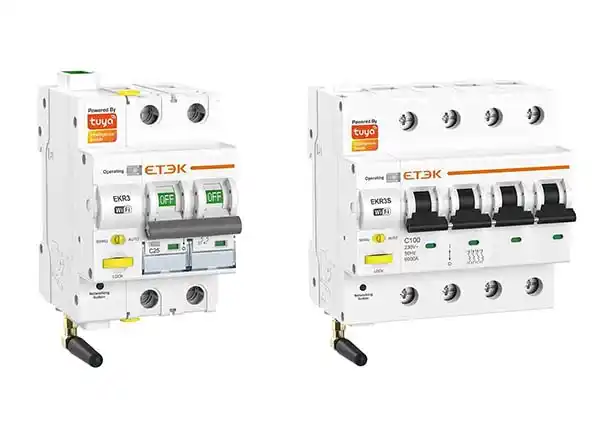
Standard MCB width is measured in "modules" (TE/Module), with 1 module = 18 mm. A 1P MCB is typically 18 mm wide, while a 2P MCB is 36 mm wide. Most smart circuit breakers also come in 1‑module or 2‑module designs. However, note that if your original panel has a 12‑module DIN rail, replacing all breakers with 2‑module smart ones will leave you with only 6 positions. Before retrofitting, count the number of circuits and calculate whether the total module width exceeds the available rail length.
Depth (Enclosure Depth)
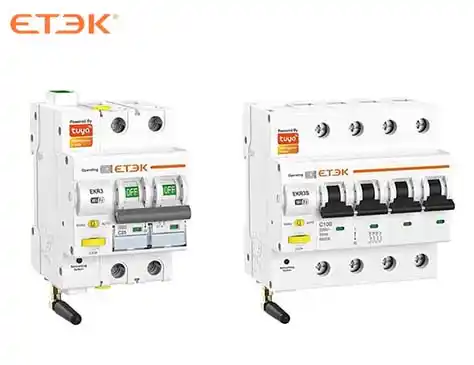
This is the most overlooked "hidden killer" in retrofits. Smart breakers integrate relays, Wi‑Fi chips, current transformers, and other electronics, so their depth is typically 15–20 mm greater than that of standard MCBs. Some models may require up to 161 mm (6.4 inches) of clear depth. We recommend measuring the internal clearance from the DIN rail to the inside of the cover with a ruler – if the smart breaker touches the cover, you will not be able to close the panel properly, and heat dissipation or antenna signal may be compromised.
Working Space
Beyond device dimensions, wiring access is critical. NEC 300.14 requires at least 6 inches (≈152 mm) of conductor length outside the enclosure and 3 inches (≈76 mm) inside. If the original panel has insufficient wire slack, rewiring may be necessary, significantly increasing labour and time.
Electrical Compatibility – Voltage and Current Ratings
Voltage Matching
Smart circuit breakers typically operate over a wide range of 110–277 V AC, suitable for both single‑phase and three‑phase systems. Still, you must verify that the nominal voltage of each circuit falls within the device’s specified range – especially in older buildings where non‑standard voltages may exist.
Current Range
The built‑in current transformer (CT) of a smart breaker has an upper limit. Currently, most all‑in‑one smart breakers are rated from 1 A up to 63 A or 80 A. For circuits exceeding 63 A, an integrated smart breaker may not be sufficient. In such cases, consider using an external CT paired with a standard breaker, or a separate monitoring module that supports external CTs.
Neutral Wire Requirement
This is one of the most frequently missed electrical compatibility issues. Smart breakers typically require a neutral connection to power their internal IoT module. In some older panels, branch circuits may only have a phase conductor and an earth conductor, with no separate neutral brought to the breaker position – meaning you may need to pull new neutral wires. Even more critically, some brands require that the neutral terminates directly on the breaker itself, not on a common neutral terminal block.
Communication – Wired vs Wireless Retrofit
The choice of communication method directly affects installation effort, signal reliability, and ongoing maintenance costs.
Wired (RS485 Modbus)
RS485 is the most mature and reliable communication protocol for industrial control and building automation. Smart breakers with RS485 can be daisy‑chained via shielded twisted‑pair cables and integrated into an existing BMS. The downside: you must run communication bus cables inside each panel, which may involve drilling and cable trays – a significant impact on finished buildings.
Wireless (Wi‑Fi, Zigbee)
Wireless solutions require no extra cabling, making installation quick. But the metal enclosure acts as a Faraday cage, severely attenuating Wi‑Fi and Zigbee signals. Common workarounds include mounting an external antenna on the panel door, or installing a DIN‑rail Zigbee gateway inside the panel to act as a signal repeater.
Hybrid (Gateway‑based)
A pragmatic compromise: install a gateway inside each distribution board. The gateway collects data from all smart breakers via RS485 or Zigbee, then uploads it to the cloud or a local server via Ethernet or 4G. This avoids the signal shielding problem while reducing the amount of individual wiring.
Power Supply for the Smart Electronics
The electronic module of a smart breaker needs auxiliary power. Two main approaches exist:
Self‑powered from the phase conductor
These models draw power directly from the monitored phase. They are easy to install but have a drawback: if that circuit is de‑energised, communication and monitoring stop immediately, and you cannot report a power‑loss event.
External 24 V DC supply
These models require a separate 24 V DC power supply module. The advantage is that they can maintain communication during a mains outage, allowing outage alerts. The disadvantages: extra space on the DIN rail and added hardware cost. When planning, remember to include the power supply width in your total rail capacity calculation.
Step by Step Retrofit Assessment
Before purchasing and scheduling installation, run through this checklist:
- Inventory circuits – Record each circuit’s load type, rated current, and typical operating current.
- Measure space – Measure clear depth and remaining module positions on the DIN rail.
- Confirm communication protocol – Determine whether integration with an existing BMS is required and which protocol it supports.
- Calculate auxiliary power – Sum the power consumption of all smart breakers and decide whether an external 24 V DC supply is needed, and its capacity.
- Select the model – Choose a suitable smart breaker based on the data above. If space is tight, prioritise 1‑module compact designs.
Cost vs Benefit – When Retrofit Makes Sense
Good candidates for retrofit
-
Few distribution boards and not too many circuits, so installation work is manageable.
-
Need for sub‑metering tenant or departmental electricity consumption for cost allocation.
-
Panels are 10–20 years old but still in good structural condition with no insulation degradation.
-
Budget allows for ongoing software/platform fees.
Consider full panel replacement when
-
Panels are over 20 years old with rust, deteriorated insulation, or obsolete design.
-
No space remains inside the panel for additional power supplies or gateways.
-
The original enclosure has a low IP rating – not suitable for sensitive electronics.
ROI analysis
Through load scheduling and energy optimisation, smart breakers typically save 20% on energy costs and 40% on maintenance costs. For a medium commercial building with 20 panels, the initial outlay is usually recovered within 12–18 months through electricity savings.
Frequently Asked Questions About Retrofit
Q: Do I need to shut down power for the whole building during retrofit?
Yes. Because you will be working inside the main distribution boards, schedule the work during weekends or low‑load night hours, and strictly follow LOTO procedures.
Q: Can I mix smart and dumb breakers on the same DIN rail?
Yes, as long as the total width does not exceed the rail length. However, keep wiring neat and clearly labelled for future maintenance.
Q: Will smart breakers affect coordination with upstream RCCBs?
No. Smart breakers add only measurement and communication functions; their overcurrent and short‑circuit protection characteristics remain the same as traditional MCBs.
Q: What happens to data if the communication cable is cut?
The breakers continue to operate normally. Data is stored locally and will be automatically uploaded once communication is restored.
Summary – Three Cases Where Retrofit Is Not Recommended
Based on the above analysis, we do not recommend retrofitting smart circuit breakers in the following three situations:
-
No remaining space inside the panel for power supplies and gateways – forcing them in may cause overheating and safety hazards.
-
The original panel has a low IP rating – dust and moisture will drastically shorten the lifespan of electronic devices.
-
Budget cannot cover ongoing software platform fees – the full value of smart breakers relies on data analytics and remote management; without the platform, the retrofit delivers little benefit.
In conclusion, retrofitting smart circuit breakers into old distribution boards is feasible, but "can I install it" and "is it worth installing" are two very different questions. We strongly recommend completing the five‑step checklist before making a final decision.